
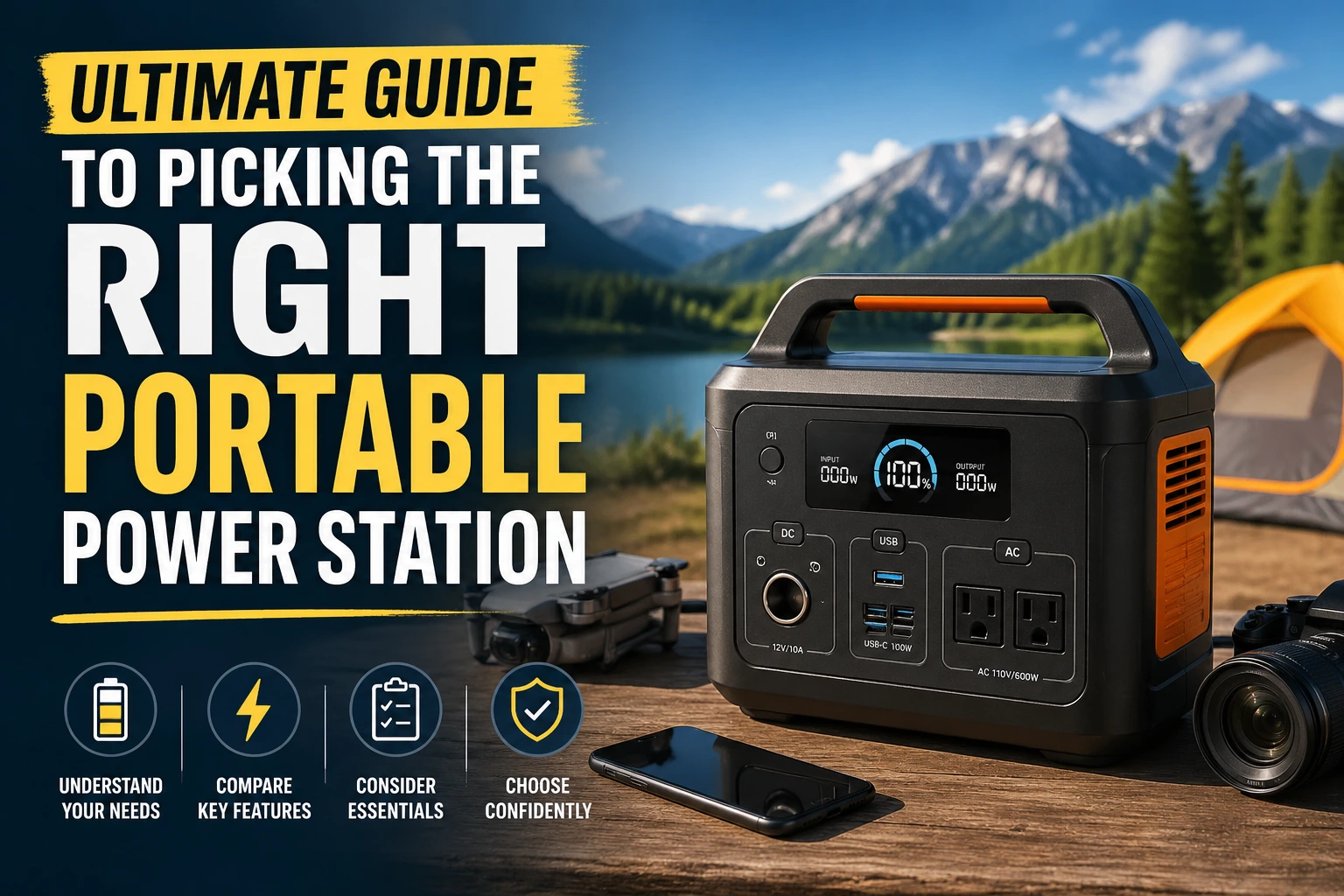
Ultimate Guide to Picking the Right Portable Power Station

You only realize how important a portable power station is when it fails you. Imagine you’re on a camping trip, your phone is dying, your camera batteries are drained and your “500W” power station can’t even run your gear properly. Or worse, during a power outage, your unit can’t handle your fridge startup surge. That’s money wasted and a problem you could’ve avoided.
This guide is for practical buyers, people who want the right power station, not just the most expensive one. No fluff, no marketing hype. You’ll learn exactly how to calculate your needs, what specs actually matter, and how to avoid common mistakes. Let’s get straight into the framework.
How to Pick the Right Portable Power Station?
Before you look at brands or aesthetics, you need to look at the numbers. Picking a power station is basically a juggle between Capacity (amount of energy in the power station), Output (power the power station can supply at a given time), and Portability, so let’s see what else matters –
Understand Your Power Needs First
To be honest, most people skip this step. That is exactly why they end up with the wrong unit. Before you even start browsing, sit down and make a list of every device you plan to use with the power station. This can be your phone, laptop, CPAP machine, mini fridge, power drill or whatever you need to use. Then look up how much power each device uses.
To do this correctly, you need to differentiate between running and surge watts (the power a device uses while on). A fridge may be using 100W of power, but requires 600W to switch on the compressor.
To find out how much capacity you need, use this: Why needed = device watts x hours of use. For example, to run a 60W laptop for 10 hours, you will require a 600Wh station. Simple as that.
Battery Capacity
While buying, Watt-hours (Wh) is the only number that truly matters. Some brands will try to distract you with “mAh” (milliamp hours), but without the voltage context, that number is misleading.
- 200–500Wh: Perfect for weekend trips, charging phones, and running LED lights.
- 500–1000Wh: The “sweet spot” for extended camping or remote work.
- 1000Wh+: Heavy-duty territory for home backup and high-draw appliances.
Pro Tip: Real-world capacity is usually ~85-90% of what’s on the box. Energy is lost as heat during the conversion from DC to AC. If you need exactly 500Wh, buy a 600Wh unit to be safe.
Battery Type
This is probably the most overlooked spec, and it has a massive impact on long-term value. There are two main batteries on the market right now:
- LFP (LiFePO4): Safer battery, much longer lifespan, typically 2,000 to 3,500 charge cycles before significant degradation. Less energy-dense, so the unit will be heavier for the same capacity. Best for home backup and anyone who’ll use it regularly.
- NMC (Lithium-ion): More energy-dense, which means lighter units. But you’re looking at 500–1,000 cycles at most. Fine for occasional use, but not great if you’re relying on it weekly.
So, if you’ll use it weekly or need it to last a decade, get LFP. If it’s an occasional camping unit and weight matters more, NMC is more suitable.
Read More: এই গরমে বাঁচাবে সেরা ৫টি পোর্টেবল পাওয়ার স্টেশন
Output Power
Capacity is how much gas is in the tank; Output Power is how fast a car can go. This is calculated by the Inverter.
For example, a 1000Wh station having 500W inverter cannot power a 700W coffee maker. The machine simply won’t start. Always check the “Continuous Output” rating. In the case of kitchen appliances or power tools, seek at least 1000W-1500W power. When all you are doing is charging a laptop and a drone, then 300W is sufficient.
Port Options & Compatibility
This is one of those things that seems minor until you are actually using the power station and realize you do not have the right connections. Before purchasing, think about how many devices you are going to run simultaneously, then look up the port layout –
- AC outlets: Check the voltage (110 V in the US, 220 V in other places) and verify the amperage per outlet.
- USB-C: Look for at least one 60W or 100W USB-C port. This allows you to charge laptops directly without using the AC brick, saving roughly 15% of your battery life.
- USB-A: These are still useful for devices, power banks and small gadgets.
- DC car port: This is handy for vehicle accessories, car fridges or certain medical devices like CPAP machines.
- Input port: If you plan to add solar panels, make sure the portable power station is compatible with them.
Recharging Speed and Input Options
The size of a battery is as good as how well you can recharge it. In 2026, you cannot afford to have a unit that requires a full day to charge. So, check the features like Fast Charge; new stations can now achieve 80% capacity in less than 90 minutes through a normal wall outlet.
When going off-grid, make sure that the unit has an in-built MPPT controller. This brain will maximize the output of your solar panels, wringing out the last drop of energy even on a cloudy day.
To have the final configuration, select a model that offers dual-charging. This will enable you to use solar and wall power at the same time, significantly reducing your downtime and enabling you to get back on your adventure or have your home backup available to you at any time.
Weight, Size, and Portability Trade-offs
When it comes to power stations, more power usually means more weight. There’s no real workaround here. That’s why it’s important to choose a size that fits your use case.
- Under 10 lbs: Actually portable. It can be easily carried in a bag. Good for backpacking, travel, and day trips.
- 10-30 lbs: Car camping distance. Has a handle, but you’re not going to carry it far. Suitable for overlanding or tail-gating.
- 30 lbs and over: If the portable power station is over 30 pounds, it is like something you would use for home backup. Most of these come with wheels because they are so heavy.
One feature that is worth paying for is replaceable battery packs. Some brands let you stack additional battery packs to increase capacity without buying a whole new unit. When you believe that you could have more needs at that point, that future-proofing is well worthwhile.
Safety Features
Since a portable power station is essentially a high-capacity energy vault sitting in your living room or tent, safety is paramount. The most critical component is the Battery Management System (BMS). This is the circuit that prevents overcharging, over-discharging, short circuits, and temperature-related damage. Every decent unit has one but quality varies.
For those running high-wattage appliances like heaters or fridges, active thermal management usually in the form of quiet, high-efficiency fans, is a must to keep internal temperatures stable.
Finally, never skip on certifications. Look for a UL or ETL rating; these are the industry’s gold standards for fire safety and electrical integrity. And, if you’re using it outdoors in rain or dusty environments, check for an IP rating. Not all stations have one and if yours doesn’t, keep it protected.
Read More: পোর্টেবল পাওয়ার স্টেশন কী? কেন আপনার একটি পাওয়ার স্টেশন দরকার
Best Use Cases (Match Your Needs)
Once you know your specs, match them to your scenario. Here’s a quick view:
| Use Case | Capacity | Key Features | Priority Spec |
| Day Hiking | <300Wh | Lightweight (<10 lbs) | USB-C PD (60W+) |
| Car Camping | 500 –1000Wh | Solar input | AC outlets |
| Home Backup | 1000Wh+ | LFP battery | High inverter wattage |
| Job site/ tools | 1000Wh+ inverter | High surge capacity | Durable build |
Use this as your filter. If a station doesn’t meet the key spec for your use case, move on.
How to Maximize Your Budget
Spending more doesn’t always mean getting more. Here’s where to put your money and where not to.
Prioritize (Don’t Miss These):
- True LiFePO4 Chemistry: It costs more upfront but lasts 5x longer than standard lithium.
- High-Speed USB-C PD: Directly charging your phone/laptop is the most efficient way to use the battery.
Skip (Avoid These Upsells):
- Wireless Charging: It’s slow, generates heat (which kills batteries), and is mostly a gimmick.
- Built-in Flashlights: You have a phone or a headlamp. Don’t pay extra for a bulky LED on your power station.
- Brand Over Specs: Don’t pay a 40% premium just for a logo. Many lesser-known brands use the same Tier-1 LFP cells as the big names.
- Price-Based Decisions: The most expensive isn’t always the best, and the cheapest is often dangerous. Look for the “Value per Watt-hour.”
Final Verdict
The perfect portable power station is the one that fits your actual requirements in the real world – not the one that has the most digits on the box or the most household name. Begin with your wattage needs, select the correct capacity and inverter output, consider LFP when you want to know how long it will last, and ensure that the ports and recharge options are the right fit to how you are going to use it.
When making a purchase, remember to get original products with a good warranty and support. You can check out Apple Gadgets to get trusted options and quality service.
FAQ
Can a portable power station run a refrigerator?
Yes, but you need a station with high “Surge Power” (usually 1000W+) and at least 1000Wh of capacity to keep it running overnight.
How long does a portable power station last on one charge?
It depends entirely on the load. A 500Wh station will run a 50W device for about 9 hours (accounting for efficiency loss).
Can I use a portable power station indoors?
Yes, you can use a portable power station indoors. Unlike those gas generators, portable power stations do not produce any fumes or noise, which makes them completely safe for use.
What’s the difference between a power station and a generator?
Generators make power, they use fuel to do this. Portable power stations store power, like a battery. Portable power stations are silent. You do not have to do a lot of maintenance on them and they are safe to use indoors.
How do I charge a portable power station with solar panels?
You just plug the output cable from the panel into the input port of the portable power station. The controller that is built into the power station will take care of everything else.
Mohammad Shariful Islam is the CEO and MD of Apple Gadgets, a leading e-commerce and retail chain for gadgets in Bangladesh. He has a passion for technology, entrepreneurship, and holds a decade of experience in gadget E-Commerce. He’s committed to providing the best possible shopping experience for customers by delivering the latest and trendy gadgets.