5 Best Graphics Cards for Gaming: From Budget to Ultimate Performance

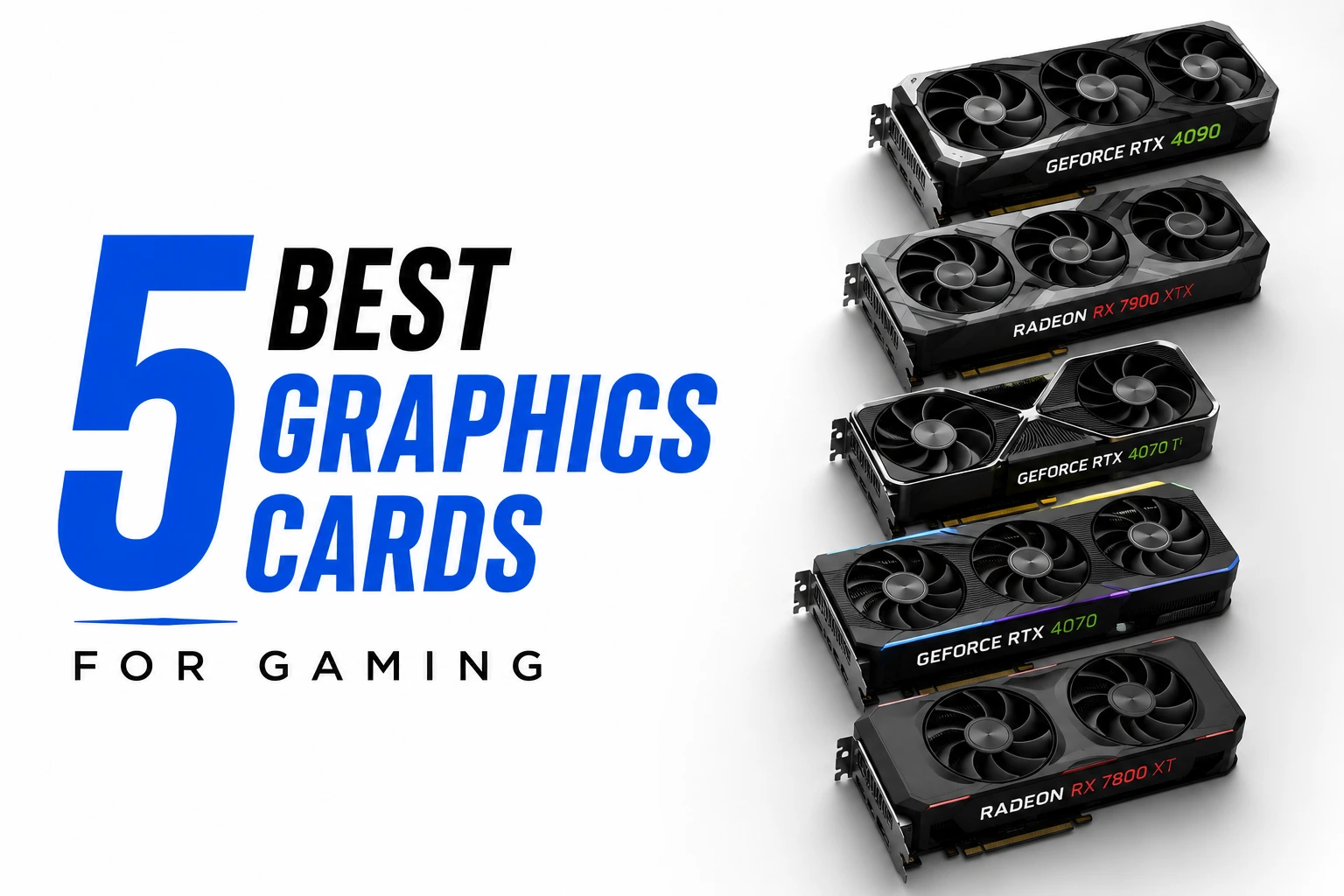
Picking a graphics card is confusing. Too many names, too many numbers, prices all over the place. This list makes it simple. We picked 5 cards that fit different needs and budgets, from a top-end beast like RTX 5090 for people who want the best of everything, to a card that handles normal gaming without costing a lot.
New desktop computers or old PC upgrade, one of these will work for you. We looked at real specs, real cooling, and what each card is actually good for. No fake hype, no calling something “amazing” just because it’s costly. See the full lineup in our graphics card category and check what’s available right now. Simple rule pick based on what you play, not what sounds fancy.
MSI GeForce RTX 5090 32G LIGHTNING Z — Best Overall Graphics Card for Gaming
Key Specs:
- GPU: NVIDIA GeForce RTX 5090, Blackwell chip
- Memory: 32GB GDDR7
- Boost Speed: 2730 MHz
- Cooling: Full-copper plate, hybrid-fin radiator
This card is for people who don’t want to settle for less. MSI’s Lightning series is always at the top, and this one takes it even further. It runs on NVIDIA’s new Blackwell chip with fifth-gen Tensor Cores, so smart features like DLSS 4 work at full power. Whatever you play, at whatever resolution, this card just handles it.
First thing that stands out is the cooling. A full-copper plate sits over the GPU, memory, and other key parts together, so no single spot gets too hot while the rest stays cool. That’s huge during long gaming hours when temps usually start climbing and causing lag. There’s also a small 8-inch screen built right onto the card. Sounds odd at first, but it’s handy you can see temps or speed without opening any app.
On power, this card can handle loads close to 1000W without trouble. So if you like pushing your card harder than normal, there’s plenty of room here. It also has two BIOS modes, so you can switch between a tuned high-performance setup and a safer everyday one whenever you want.
| Pros | Cons |
| Very high boost speed for top FPS | Needs a strong power supply |
| Copper cooling keeps it cool even under heavy use | Costly, not for casual buyers |
| Strong build with carbon fiber back panel | |
| Lots of power room for pushing it harder |
ASUS ROG Astral RTX 5090 32GB OC Edition — Best Premium Flagship Card
Key Specs:
- GPU: NVIDIA GeForce RTX 5090, Blackwell chip
- Memory: 32GB GDDR7
- Cooling: Four fans with vapor chamber
- Power Setup: 80-amp parts
Want a card that looks just as serious as it performs? This is it. ASUS made this their first ever four-fan card, and that fourth fan really does something. It pushes airflow up by 20%, which means lower heat and fewer hot spots even after hours of gaming.
What sets this one apart from regular RTX 5090 cards is how it handles power. ASUS used stronger 80-amp parts here, giving 35% more room than normal cards. That keeps performance steady when you’re running tough games on max settings, especially in 4K. There’s also a special vapor chamber that improves heat transfer by over 10%, working with the fans so it stays cool without getting loud.
Build quality is something people often skip thinking about. This card has a solid metal frame and a coating that protects it from dust and moisture, so it’s made to last for years, not just look good when it’s new.
| Pros | Cons |
| Four-fan design cools much better | Big size, needs a roomy PC case |
| 35% extra power room for steady performance | Pricey compared to normal OC cards |
| Strong metal build with protective coating | |
| Good for pushing it harder than stock |
Manli Nebula GeForce RTX 5080 16GB GDDR7 — Best High-End Graphics Card for 4K Gaming
Key Specs:
- GPU: NVIDIA GeForce RTX 5080
- Memory: 16GB GDDR7, 30Gbps
- Boost Speed: 2617 MHz
- Cooling: Triple-fan with vapor chamber
This is where most serious gamers actually want to land, strong enough for 4K, but without flagship pricing. The RTX 5080 chip has 10,752 CUDA cores and can boost up to 2617 MHz, more than enough to keep frame rates high in today’s big games on max settings.
What helps a lot here is the 16GB GDDR7 memory running at 30Gbps. That gives almost 960GB/s of speed, so textures load fast and nothing stutters even in games that eat up memory. If you’ve ever had a card run out of memory mid-game, you’ll like having this much room.
Cooling comes from three fans paired with a vapor chamber, so it stays stable even during long sessions. The build uses a solid metal shroud and back panel, so it won’t bend or flex over time, which matters more than people realize for a card this size.
| Pros | Cons |
| Great price-to-performance ratio for 4K setups | Visual design looks simple |
| 16GB GDDR7 memory with fast speed | |
| Steady triple-fan cooling | |
| Solid metal build |
Manli Nebula GeForce RTX 5070 12GB GDDR7 — Best Mid-Range Graphics Card for Gaming
Key Specs:
- GPU: NVIDIA GeForce RTX 5070
- Memory: 12GB GDDR7, 28Gbps
- CUDA Cores: 6144
- Power Use: 250W
For most gamers, this is the sweet spot. You’re not paying flagship prices, but you still get GDDR7 memory and a modern chip that handles 1440p gaming with ease. The RTX 5070 has 6144 CUDA cores, enough to run popular games smoothly without constantly turning settings down.
The 12GB GDDR7 memory runs at 28Gbps, giving up to 672GB/s of speed. That’s a big step up from older GDDR6 cards at similar price, meaning smoother play in newer games that need more memory speed. If you game and also edit videos or stream sometimes, this card handles all of that without slowing down.
It uses the same trusty triple-fan setup as the bigger model, so cooling stays steady. Power use sits at 250W, which is easy on most mid-range builds without needing a new power supply.
| Pros | Cons |
| Great mix of price and power | Not made for heavy 4K gaming |
| 12GB GDDR7 handles 1440p well | Less room for pushing it harder than top models |
| Doesn’t draw too much power | |
| Stays cool under load |
PowerColor Hellhound RX 9060 XT 8GB GDDR6 — Best Budget Graphics Card for Gaming
Key Specs:
- GPU: AMD Radeon RX 9060 XT, RDNA 4
- Memory: 8GB GDDR6
- Boost Speed: 3310 MHz
- Power: One 8-pin plug
Not everyone wants to spend big on a graphics card, and that’s exactly where this one fits. Built on AMD’s newer RDNA 4 chip, this card runs 1080p and 1440p gaming smoothly, which covers what most regular gamers actually play.
Boost speed goes up to 3310 MHz, which is genuinely fast for this price. Paired with 2048 stream processors, it runs today’s big games without major drops. Ray tracing is included too, so you’re not missing out on nice lighting effects just because you went budget.
Power need is low just one 8-pin plug, so it works fine with older or smaller power supplies. That’s a real plus if you’re upgrading an old PC and don’t want to also buy a new power supply.
| Pros | Cons |
| Highly affordable entry into modern gaming setups | Ray tracing speeds are moderate |
| Smooth at 1080p and 1440p | |
| Low power need, easy on older builds |
Things to Know Before Buying a Graphics Card
Before picking one, think about what resolution you actually play at. No point paying for a 4K monster if your screen only does 1080p. Check your power supply and case size too, especially for big cards like the RTX 5090 models. Memory matters, more memory means your card stays useful longer as games get heavier. And don’t forget your CPU, since a strong GPU paired with a weak processor won’t show what it can really do.
Final Thoughts
So that’s it, five solid picks for every kind of gamer. If money’s not a worry, MSI’s Lightning Z or ASUS ROG Astral RTX 5090 give you the best graphics card for gaming you can get right now. Want 4K without flagship pricing? Go with Manli’s RTX 5080. Most people though will find the RTX 5070 hits that perfect middle spot for 1440p gaming. And if your budget’s tighter, PowerColor’s RX 9060 XT still does the job well at 1080p and 1440p. Prices in Bangladesh right now range from around 60-70 thousand taka for budget picks, all the way up to over 5 lakh taka for top RTX 5090 cards. So there’s something here for every budget. Pick based on what you actually play, not what looks impressive on paper.
Kamrun Naher Nafisa is a passionate tech writer who loves exploring the latest products, gadgets, and consumer technology. She enjoys turning complex tech topics into simple, practical insights that help readers make smarter buying decisions and get the most from their devices.