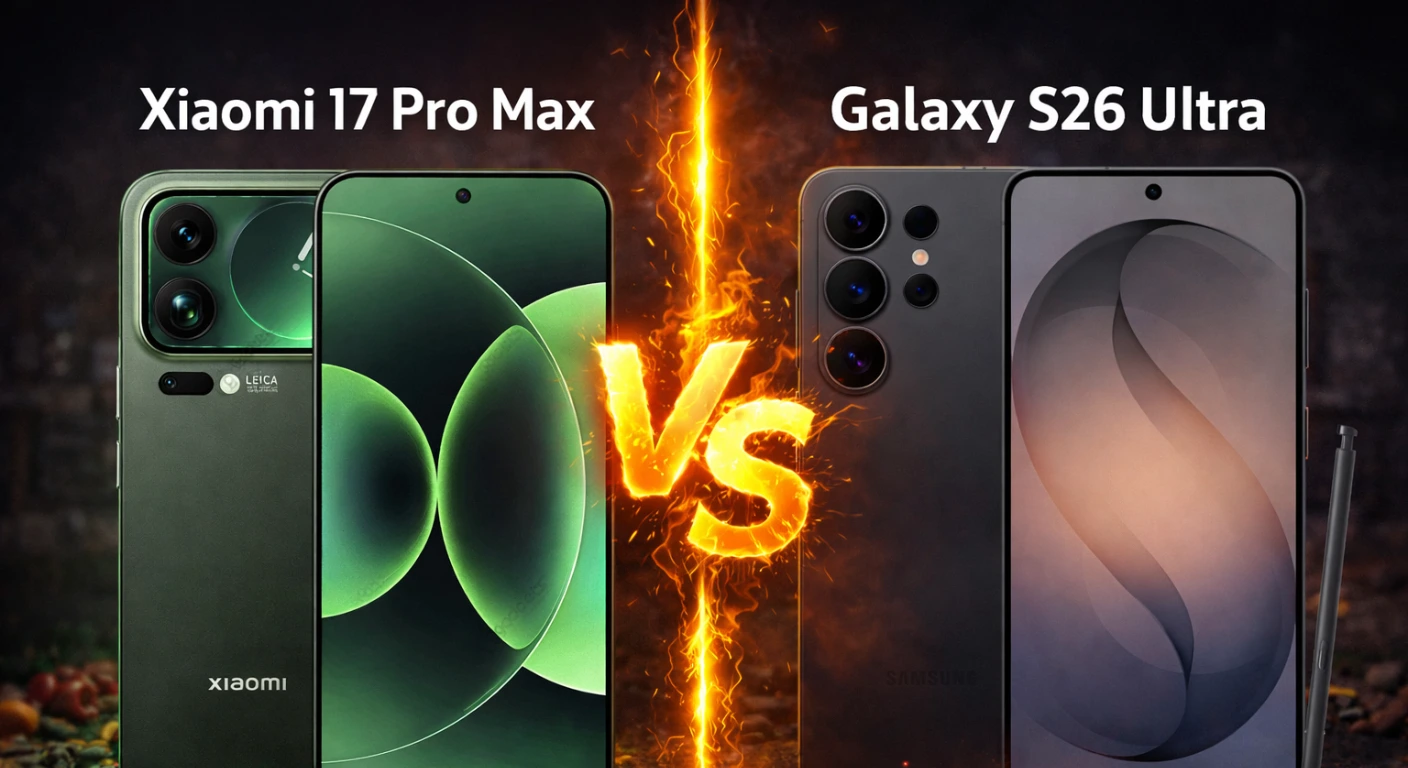
Galaxy S26 Ultra 5G vs Xiaomi 17 Pro Max: The Ultimate Flagship Showdown

Flagship smartphone competition continues to intensify as brands are continuously pushing limits of performance and innovation. Samsung Galaxy S26 Ultra enters the premium segment as a strong new contender, aiming to challenge powerful devices already on the market, including Xiaomi 17 Pro Max, which launched late last year.
Both smartphones represent the pinnacle of Android flagship technology. Featuring ultra-bright AMOLED displays, next-generation Snapdragon performance, advanced camera systems, and massive batteries, these devices are designed for users seeking the ultimate smartphone experience. Let’s take a closer look at what these two giants offer and see how they compare.
Design and Build Quality
| Aspect | Samsung Galaxy S26 Ultra 5G | Xiaomi 17 Pro Max |
| Dimensions | 163.6 × 78.1 × 7.9 mm | 162.9 × 77.6 × 8 mm |
| Weight | 214 g | 219 g |
| Frame Material | Aluminium | Aluminium |
| Rear Panel | Glass | Fiberglass |
| Water Resistance | IP68 | IP68 |
| Cooling System | Vapor chamber | Vapor chamber |
| Fingerprint Sensor | In-display | In-display |
When comparing flagship smartphones like Samsung Galaxy S26 Ultra 5G and Xiaomi 17 Pro Max, design and build quality play an important role in everyday usability. Both devices follow a premium design approach with slim bodies, durable frames, and water-resistant construction. While the differences in size and weight are small, they can still affect comfort in hand and overall portability.
Galaxy S26 Ultra is slightly taller but also a bit lighter, which may make it more comfortable for long-term use. Its glass rear panel adds a premium feel while maintaining a slim profile. On the other hand, Xiaomi 17 Pro Max is marginally thicker and heavier, but the difference is small enough that most users may not notice it during daily use.
Both smartphones come with IP68 water and dust resistance, offering protection against splashes and accidental exposure to water. They also feature advanced vapor chamber cooling systems to help manage heat during heavy tasks like gaming or video recording. Overall, both models deliver a solid flagship build with durable materials and modern biometric security through in-display fingerprint scanners.

Xiaomi 17 Pro Max
Flagship display, Leica camera system, and powerful performance in a premium design.
- LTPO AMOLED display with smooth and vibrant visuals
- Secondary back display adds style and smart convenience
- Latest chipset ensures fast multitasking and gaming
- Triple Leica cameras for stunning pro-level photography
- Stereo speakers with immersive Dolby Atmos sound
Display
| Aspect | Samsung Galaxy S26 Ultra | Xiaomi 17 Pro Max |
| Display Type | Dynamic AMOLED, 120Hz, HDR10+ | AMOLED, 120Hz, Dolby Vision |
| Screen Size | 6.9-inch, 90.30% screen-to-body | 6.9-inch, 93.16% screen-to-body |
| Resolution | 3120 × 1440 pixels | 2608 × 1220 pixels |
| Pixel Density | 498 PPI | 417 PPI |
| Peak Brightness | 2600 nits | 3500 nits |
| Protection | Corning Gorilla Glass Armor 2 | Dragon Crystal Glass 3 |
Display is a major highlight of modern flagship smartphones, especially for users who spend a lot of time watching videos, gaming, or browsing. Both Samsung Galaxy S26 Ultra 5G and Xiaomi 17 Pro Max feature large 6.9-inch screens with a 120Hz refresh rate, ensuring smooth scrolling and fluid animations. However, these two phones focus on different strengths when it comes to resolution, brightness, and display technology.
Galaxy S26 Ultra offers a higher resolution and pixel density, which can produce sharper text and finer details when reading articles, editing photos, or watching high-resolution content. This can be especially noticeable when holding the phone close or using it for productivity tasks.
On the other hand, Xiaomi 17 Pro Max stands out with a significantly higher peak brightness and a slightly larger screen-to-body ratio. This makes the display easier to see under direct sunlight and more immersive when watching HDR movies or streaming content. With Dolby Vision support, it can also deliver richer contrast and more dynamic colors in supported videos.
Overall, both displays are flagship-level panels with smooth 120Hz performance, but S26 Ultra prioritizes sharpness while Xiaomi 17 Pro Max focuses more on brightness and cinematic viewing.
Read More: Galaxy S26 Ultra 5G Review
Performance and Processor
If you enjoy playing demanding mobile games or often switch between multiple heavy apps, raw processing power becomes very important. Thankfully, both Samsung Galaxy S26 Ultra 5G and Xiaomi 17 Pro Max come equipped with same flagship chipset that can handle almost any task you throw at them.
| Aspect | Samsung Galaxy S26 Ultra | Xiaomi 17 Pro Max |
| Chipset | Snapdragon 8 Elite Gen 5 (3 nm) | Snapdragon 8 Elite Gen 5 (3 nm) |
| CPU | Octa-core (2×4.6GHz + 6×3.62GHz) | Octa-core (2×4.6GHz + 6×3.62GHz) |
| GPU | Adreno 840 | Adreno 840 |
| RAM Options | 12GB, 16GB | 12GB, 16GB |
| Storage Options | 256GB, 512GB, 1TB | 512GB, 1TB |
| Storage Type | UFS 4.1 | UFS 4.1 |
| Expandable Storage | No | No |
| Operating System | Android 16 (up to 7 OS updates) | Android 16 |
Because both devices use the same Snapdragon 8 Elite Gen 5 processor with the Adreno 840 GPU, their real-world performance should feel very similar. Popular games like PUBG Mobile, Call of Duty: Mobile, and Genshin Impact are expected to run smoothly on high graphics settings with stable frame rates. This level of power also helps when recording 4K or 8K videos, editing photos, or running multiple apps at the same time.
In terms of memory, both phones offer up to 16GB of RAM, which is more than enough for any heavy multitasking you have to work on your phone. However, the Xiaomi 17 Pro Max starts with a larger 512GB storage option, making it a better fit for users who store a lot of large files, games, or high-resolution videos.
One area where Galaxy S26 Ultra may stand out is long-term software support. Samsung promises up to seven major Android updates, which could keep the phone updated with new features and security improvements for many years.

Galaxy S26 Ultra 5G
Ultimate flagship power built for performance, photography, and productivity.
- Snapdragon 8 Elite Gen 5 for blazing-fast gaming
- Aluminum frame with IP68 water & dust resistance
- 200MP quad camera with stunning 8K video
- Samsung DeX for desktop-like productivity anywhere
Camera
| Aspect | Samsung Galaxy S26 Ultra | Xiaomi 17 Pro Max |
| Rear Camera Setup | Quad Camera | Triple Camera |
| Main Camera | 200 MP (OIS, PDAF) | 50 MP |
| Ultra-Wide Camera | 50 MP | 50 MP |
| Telephoto | 10 MP, 3× optical zoom | — |
| Periscope Camera | 50 MP, 5× optical zoom | 50 MP, 5× optical zoom |
| Main Sensor Size | 1/1.3″ | 1/1.28″ |
| Video Recording | 8K 30fps, 4K 120fps | 8K 30fps, 4K 60fps |
| Front Camera | 12 MP | 50 MP |
For many buyers, the camera is the biggest reason to choose a flagship phone. Tendency of staying active on social media is increasing day by day among people of all ages, so capturing eye-catching photos and videos to share online has become part of everyday life. A powerful camera helps users create sharp, vibrant content that stands out on their feeds. Both Samsung Galaxy S26 Ultra 5G and Xiaomi 17 Pro Max bring powerful camera hardware, but their approach is quite different.
Galaxy S26 Ultra focuses on versatility. Its 200 MP main sensor captures incredibly detailed photos, which is especially useful for landscape shots or when cropping images later without losing clarity. The phone also includes two zoom cameras, a 3× telephoto and a 5× periscope lens. These lenses give you more flexibility when photographing distant subjects such as wildlife, sports events, or stage performances.
On the other hand, Xiaomi 17 Pro Max uses a simpler but powerful triple-camera system. Its 50 MP main sensor features a slightly larger pixel size, which can help capture more light in darker environments. The 50 MP periscope camera with 5× optical zoom also promises strong long-distance photography, making it suitable for travel and outdoor photography.
Video capabilities are also impressive on both devices. Galaxy S26 Ultra supports 4K recording at up to 120 fps for smoother slow-motion videos, while Xiaomi 17 Pro Max offers ultra-slow-motion recording at 960 fps in 1080p. Meanwhile, selfie lovers may prefer the Xiaomi device since it features a much higher-resolution 50 MP front camera compared to the 12 MP camera on Samsung S26 ultra.
Overall, the Galaxy S26 Ultra stands out for its versatile multi-zoom system and extremely high-resolution main camera, while the Xiaomi 17 Pro Max focuses on a balanced setup with strong sensors and a high-resolution selfie camera.
Read More: Galaxy S26 Ultra VS iPhone 17 Pro Max
Battery Life And Charging
Long gaming sessions, video streaming, or navigation can quickly drain a phone’s battery, so capacity and charging speed matter a lot in real life. The Samsung Galaxy S26 Ultra 5G and Xiaomi 17 Pro Max both support modern fast-charging technologies, but their battery sizes are quite different.
| Aspect | Samsung Galaxy S26 Ultra | Xiaomi 17 Pro Max |
| Battery Capacity | 5000 mAh | 7500 mAh |
| Battery Type | Li-Ion | Silicon-Carbon (Si/C) |
| Max Charging Power | 60 W | 100 W |
| Wireless Charging | 25 W | 50 W |
| Reverse Charging | Yes (Wireless) | Yes (Wireless) |
| Fast Charging | 84% in 30 minutes | 82% in 30 minutes |
| Full Charging Time | ~43 minutes | ~48 minutes |
The Xiaomi 17 Pro Max stands out with its massive 7500 mAh silicon-carbon battery, which should deliver noticeably longer usage during gaming, video streaming, or heavy multitasking. It also supports faster wired and wireless charging speeds.
Meanwhile, the Galaxy S26 Ultra offers a smaller 5000 mAh battery but still provides fast charging and wireless charging support, along with a slightly quicker full charging time. Overall, Xiaomi leads in battery capacity and charging power, while Samsung focuses on balanced efficiency.
Software and User Experience
| Aspect | Samsung Galaxy S26 Ultra | Xiaomi 17 Pro Max |
| Operating System | Android 16 | Android 16 |
| Software Updates | Up to 7 major OS updates | Up to 6 year |
| User Interface | Samsung One UI | Xiaomi HyperOS |
| Customization | Extensive | Extensive |
| Security Updates | Long-term support | Standard support |
Beyond hardware, software experience plays a big role in how a phone feels during everyday use. From interface design to long-term updates, operating systems can affect performance, security, and the availability of new features over time. Samsung Galaxy S26 Ultra 5G and Xiaomi 17 Pro Max run on the same latest version of Android 16. It ensures access to modern features and improved system optimization.
Samsung’s software experience is powered by One UI, which is known for its clean layout, productivity features, and strong ecosystem integration with other Samsung devices. A major advantage here is Samsung’s promise of up to seven major Android updates, which can keep the phone secure and feature-rich for many years.
Meanwhile, Xiaomi uses HyperOS, which focuses on smooth animations, deep customization, and strong system optimization. It also integrates well with Xiaomi’s ecosystem of smart devices and gadgets.
In everyday use, both systems are smooth and feature-packed. However, Samsung may have an edge for users who prioritize long-term software updates, while Xiaomi offers a highly customizable and visually dynamic interface.
Connectivity
| Aspect | Samsung Galaxy S26 Ultra | Xiaomi 17 Pro Max |
| Network | 5G | 5G |
| Wi-Fi | Wi-Fi 7 | Wi-Fi 7 |
| Bluetooth | Bluetooth 6 | Bluetooth 5.4 |
| Fingerprint Sensor | In-display | In-display |
| Speakers | Stereo speakers | Stereo speakers |
| Special Features | S Pen support | Advanced cooling system |
Besides core hardware, connectivity and extra features also shape the overall user experience. Both the Samsung Galaxy S26 Ultra 5G and Xiaomi 17 Pro Max support modern connectivity standards and include several flagship-level features.
Both phones support fast 5G connectivity and Wi-Fi 7, ensuring smooth streaming, gaming, and fast downloads. With the Galaxy S26 Ultra stands out with S Pen support for productivity tasks like note-taking, while the Xiaomi 17 Pro Max focuses more on maintaining stable performance with its advanced cooling system.
Galaxy S26 Ultra 5G vs Xiaomi 17 Pro Max: Price in Bangladesh
When considering flagship smartphones, price in Bangladesh is an important factor alongside features and performance. The Samsung Galaxy S26 Ultra 5G is positioned as a premium all-rounder with high-resolution cameras and S Pen support, while the Xiaomi 17 Pro Max focuses on delivering strong performance, a massive battery, and fast charging at a slightly more affordable price.
And the best way to find the actual price in Bangladesh of Samsung S26 Ultra and Xiaomi 17 Pro max you should go to a renowned and authentic shop.
Key Aspects at a Glance
| Aspect | Samsung Galaxy S26 Ultra | Xiaomi 17 Pro Max |
| Design & Build | Slightly taller, lighter, glass rear panel, S Pen support | Slightly thicker, heavier, aluminum frame, advanced cooling |
| Display | 6.9″ Dynamic AMOLED, 120Hz, HDR10+, 3120×1440px | 6.9″ AMOLED, 120Hz, Dolby Vision, 2608×1220px, brighter |
| Processor & RAM | Snapdragon 8 Elite Gen 5, 12–16GB | Snapdragon 8 Elite Gen 5, 12–16GB |
| Camera | 200 MP main, quad rear cameras, versatile zoom | 50 MP main, triple rear cameras, strong periscope zoom |
| Battery & Charging | 5000 mAh, fast and wireless charging | 7500 mAh, faster wired and wireless charging |
| Software | Android 16, One UI, up to 7 OS updates | Android 16, HyperOS, standard updates |
| Extra Features | S Pen, stereo speakers | Advanced cooling, stereo speakers |
At The End
Choice often comes down to personal priorities, Galaxy S26 Ultra brings sharp cameras, a refined design, and software that will feel reliable for years. S Pen support makes it handy for quick notes, sketches, or staying organized in everyday life.
Xiaomi 17 Pro Max stands out for long-lasting battery and smooth performance under heavy use. Gaming, video streaming, or juggling multiple apps won’t feel stressful, and the bright screen keeps everything clear and lively.
Both phones have their strengths, and either one can keep up with a busy day. In the end, it’s about what fits your lifestyle best, but no matter which you pick, you’ll be holding a phone that feels premium, capable, and ready for whatever comes next.
Borhan Uddin Alif is a writer with 3 years of experience, focusing on technology, marketing, and storytelling, and enjoys exploring various niches and topics.