
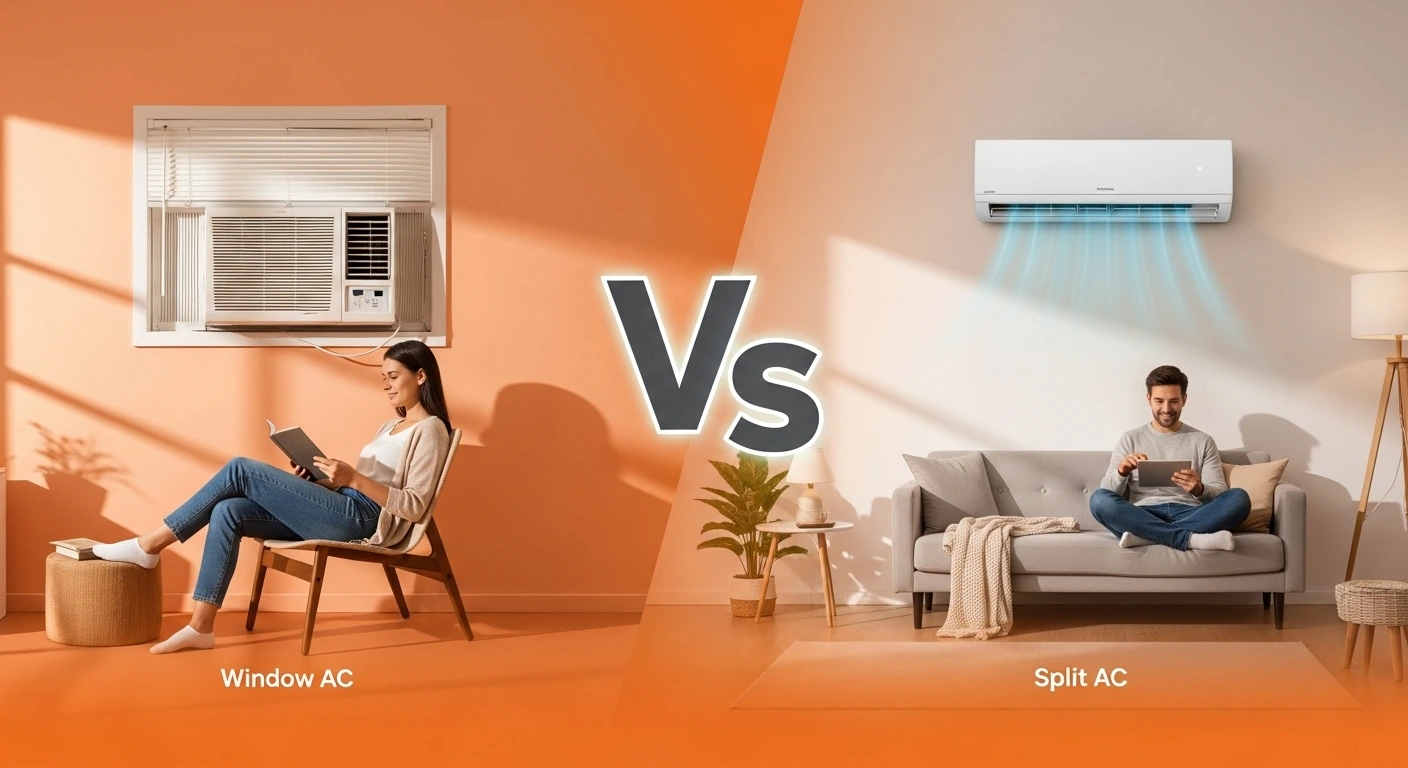
Window AC vs Split AC: Which One Should You Buy?

Hot days in Bangladesh can turn even a cozy room into a small furnace. At that point, an AC isn’t a luxury, it feels like a lifeline. But once you decide to buy one, the big question comes in: should you go for a window AC or a split AC?
Both have their own charm. A window AC is simple, compact, and often kind to your wallet. A split AC is sleek, quiet, and gives your room a modern vibe. Some people love the low cost and easy setup of a window unit, while others enjoy the comfort and elegance of a split system.
This guide is here to help you figure out which one actually fits your lifestyle. We’ll look at the small details that make a big difference, cost, comfort, energy use, and even how your room feels when the AC runs. By the end, you’ll know which side of the debate matches your needs best.
Quick Comparison: Window AC vs Split AC
Before going into the details, here’s a simple comparison to help you see the differences at a glance. This table will give you a clear idea of what to expect from each type of AC.
| Factor | Window AC | Split AC |
| Price | Lower upfront cost | Higher upfront cost |
| Installation | Easy, needs a window or wall space | Professional setup with indoor and outdoor unit |
| Energy Efficiency | Decent, fewer inverter options | High efficiency, inverter models widely available |
| Noise | Louder since all parts are in one box | Quieter, compressor stays outside |
| Design & Look | Bulky, visible from window | Sleek and modern |
| Room Suitability | Best for small rooms | Works for small to large rooms |
| Maintenance | Easy filter cleaning, whole unit needs service if major issue | Regular servicing required, slightly higher cost |
| Smart Features | Limited options | Many models offer Wi-Fi, app control, sensors |
How They Work
To understand the real difference between window AC and split AC, it helps to know how each one works. A window AC is like an all-in-one box. Inside that box, you’ll find everything: the compressor, the cooling coil, and the fan. You place it in a window or a wall opening, and it blows cool air into the room while pushing hot air outside. Because everything is packed together, the machine makes more noise but is very straightforward to set up.
A split AC is designed differently. It has two separate units: an indoor unit and an outdoor unit. The indoor part sits on your wall and quietly spreads cool air. The outdoor part, which has the compressor, stays outside and handles the heavy work of throwing heat out. Since the noisy parts stay outdoors, the indoor environment feels quieter and more comfortable.
In short, a window AC keeps things simple in one box, while a split AC divides the job between two units for better comfort and quieter cooling.
Read More: Best AC Brand in Bangladesh
Energy Efficiency & Bills
One of the most important things to think about before buying an AC is how much power it will use. The type of AC you choose makes a big difference in your monthly bills.
A window AC can cool your room well, but most models don’t come with advanced inverter technology. That means the compressor runs at full speed until the room gets cool, then shuts off, and starts again when needed. This stop-and-start cycle uses more electricity over time.
A split AC, on the other hand, often comes with inverter technology. Instead of turning on and off, the compressor adjusts its speed based on the room’s temperature. This makes the cooling smoother and saves electricity. Inverter models also keep the room more comfortable without sudden temperature swings.
Another point is the refrigerant used. Modern split ACs mostly use R32 refrigerant, which is more eco-friendly and energy-saving compared to older gases like R410A. Some newer window ACs also use R32, but options are fewer.
If you plan to run your AC for many hours daily, a split inverter AC can cut down your bills in the long run. But if you use AC only for a short time at night or occasionally, a window AC might still make sense.
Read More: Inverter vs Non-Inverter AC
Noise, Comfort & Air Quality
Noise and comfort are very important when choosing an AC. A loud AC can disturb sleep or make working from home uncomfortable.
A window AC has all its parts in one box. That means the compressor and fan are inside the room, which makes more noise. Some window ACs can be quite loud, especially on higher cooling settings.
A split AC keeps the compressor outside. The indoor unit only blows cool air quietly, which makes it much better for bedrooms or living rooms where you want peace. Some models also have silent or sleep modes for extra quiet operation at night.
Air quality is another factor. Split ACs often have better airflow and dehumidification, which keeps the room feeling fresher. Many split models also include filters to catch dust or tiny particles, which is helpful if you live in a dusty city or near traffic. Window ACs have basic filters, but they may not clean the air as thoroughly.
In short, if quiet and fresh air are important for your comfort, a split AC is usually the better choice. Window ACs still cool well but can be louder and less gentle on indoor air quality.
Installation & Space
Installation is one of the biggest differences between window AC and split AC. A window AC is simple to set up. It is a single unit that fits into a window or a wall opening. Once placed, you just plug it in and it’s ready to cool. This makes it a good choice for small rooms or rented homes where you don’t want to spend much on installation. The downside is that you need a proper window space, and the AC will stick out both inside and outside.
A split AC needs more work during installation. It comes with two units: one inside and one outside. The indoor unit is fixed on the wall, and the outdoor unit is placed outside the building. A technician connects them with pipes and wiring. This takes more time and costs extra, but it gives you more freedom to place the AC neatly in your room. Since the bulky parts stay outdoors, the inside looks cleaner and more stylish.
If you are looking for easy setup and portability, a window AC is more convenient. If you care about room design and long-term comfort, a split AC fits better.
Room Size & Sizing Guide
Choosing the right AC is not only about type, it’s also about size. If the AC is too small, it won’t cool the room properly. If it’s too big, it will waste electricity. That’s why checking your room size is important before buying.
Here’s a simple guide you can follow:
| Room Size (Approx.) | Recommended AC Capacity |
| Up to 120 sq ft (small bedroom) | 1.0 ton |
| 121 – 180 sq ft (medium bedroom or office) | 1.5 ton |
| 181 – 250 sq ft (living room or larger space) | 2.0 ton |
| Above 250 sq ft | 2.5 ton or higher / multiple AC units |
A window AC works best for smaller rooms, usually under 150 sq ft. For bigger rooms, it may not provide enough cooling. A split AC is more flexible. It comes in many sizes and can handle both small and large rooms. If you want to cool a living room or a big space, a split AC is the smarter choice.
Keep in mind that sunlight, number of people, and floor height also affect cooling needs. A sunny west-facing room may need a higher capacity even if the size is small.
Costs: Upfront vs Running
When buying an AC, many people look at the price tag first. But the real cost also includes electricity bills and maintenance over the years.
A window AC is cheaper to buy. The installation cost is also low because it’s a single unit that doesn’t need much setup. If you’re on a tight budget or want a quick cooling solution, this is the more affordable choice.
A split AC costs more at the start. The unit itself is more expensive, and installation requires professional service, which adds extra money. But in the long run, a split AC can save you money. Most split models come with inverter technology, which cuts down on electricity use. If you run the AC for many hours every day, the lower power bills can balance out the higher upfront cost.
Maintenance is another thing to think about. Window ACs are easy to clean and repair, while split ACs need regular servicing from a technician. This makes window ACs cheaper to maintain, but split ACs often last longer with proper care.
So, the real choice depends on your usage. For short-term or limited use, a window AC is lighter on the wallet. For long-term comfort and lower bills, a split AC is a smarter investment.
Maintenance & Reliability
Taking care of your AC is important if you want it to last and keep working properly. Both window ACs and split ACs need regular cleaning and servicing, but the effort and cost are a little different.
A window AC is easier to maintain. Since everything is inside one box, you can pull out the filter and clean it yourself. Dust and dirt are the main problems, and a quick wash usually helps. If the machine needs a major repair, however, the whole unit often has to be taken out, which can be a hassle.
A split AC requires more regular servicing. The indoor unit needs filter cleaning, while the outdoor unit should be checked for dust and coil blockages. Technicians usually handle this, which means extra cost. On the positive side, split ACs are generally more reliable in the long run if you keep up with servicing. Many models also last longer than window ACs because the compressor and other heavy parts stay outside and get less indoor wear.
In short, window ACs are easier for quick home cleaning, but split ACs reward you with durability if you don’t skip regular servicing.
Climate & Building Context in Bangladesh
Bangladesh has a hot and humid climate for most of the year. From March to October, the heat can be intense, and the humidity makes it even more uncomfortable. This means air conditioners here need to do more than just cool the air, they also need to control moisture and run efficiently for long hours.
A split AC is often the better match for this kind of weather. Inverter split models can adjust their speed based on the temperature, which helps keep rooms cool without using too much electricity. They also handle humidity better, giving you a fresher and more comfortable environment.
Building design also matters. Many modern apartments in cities like Dhaka or Chattogram don’t have big windows suitable for window ACs. Split ACs work well here because the outdoor unit can be placed on balconies or outside walls. On the other hand, in older houses or small rooms with proper window openings, a window AC is still a practical option.
So, in the context of Bangladesh’s hot climate and modern apartment setups, split ACs are usually the more popular and practical choice.
Finding Your Perfect Match: Split AC or Window AC?
Choosing between a Split AC and a Window AC depends on your lifestyle, budget, and the kind of comfort you want. If you live in a rented apartment or have limited wall space, a Window AC makes sense because it is compact, affordable, and easy to install or relocate. It is best suited for small rooms and for people who prefer straightforward cooling without the hassle of high servicing costs.
On the other hand, if you are someone who values a modern look, quiet operation, and energy efficiency, a Split AC is the way to go. It works perfectly in medium to large rooms, keeps noise to a minimum, and offers advanced features like inverter technology and precise temperature control. While the initial cost and servicing expenses are higher, it gives you long-term benefits in comfort and efficiency.
So, if you’re on a tighter budget and want something practical for smaller spaces, go with a Window AC. But if you’re ready to invest a little more for better design, quieter performance, and advanced technology, a Split AC is the smarter choice.
Closing Up
At the end of the day, it’s not just a technical decision but a personal one. Think about your space, comfort needs, and future plans. Once you’re clear on that, the right air conditioner will naturally stand out as the best match for your home.
If you’re ready to bring that comfort home, explore the latest Split and Window AC options at Apple Gadgets. You’ll find trusted models at competitive prices, making it easier to choose the perfect AC for your lifestyle.
Borhan Uddin Alif is a writer with 3 years of experience, focusing on technology, marketing, and storytelling, and enjoys exploring various niches and topics.