Ultra HD vs OLED TV: The Simple Guide to Choosing Your Next TV

Hot days call for cool entertainment, and nothing beats relaxing with your favorite shows or a blockbuster movie on a big screen. But when you start looking for a new TV, one question always pops up: should you go for Ultra HD or OLED? The names sound similar, yet they’re not the same thing.
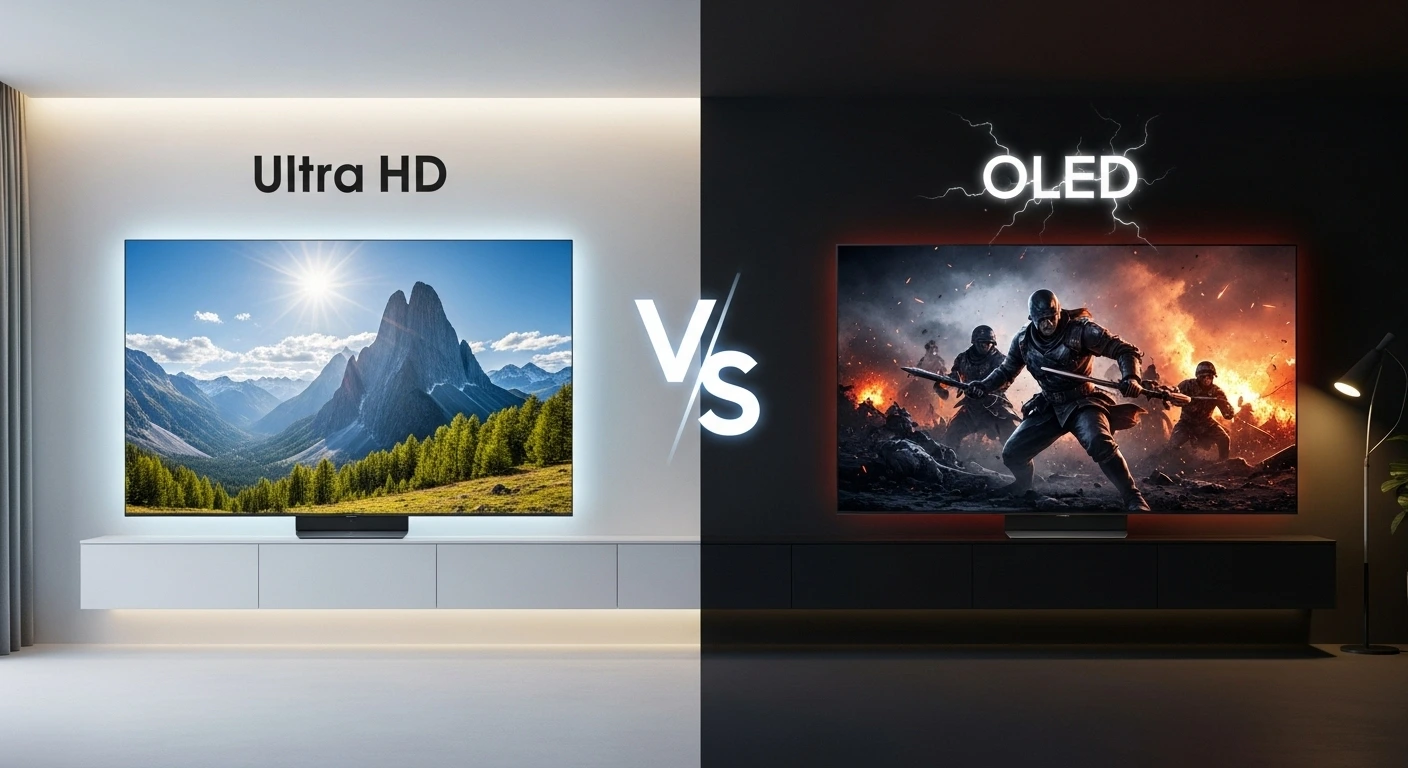
Ultra HD (also known as 4K) is all about the resolution, how sharp and detailed your picture looks. OLED, on the other hand, is about the technology inside the screen that makes colors richer, blacks deeper, and motion smoother. The confusion comes because most OLED TVs are also Ultra HD.
In this blog, we’ll clear up the differences, compare them side by side, and help you decide which one truly fits your lifestyle, room setup, and budget in 2025.
What Do These Terms Actually Mean?
Before comparing, it is important to understand the basics. Ultra HD and OLED are not the same thing, and many people get confused by the names.
What is Ultra HD (UHD/4K)?
Ultra HD, often called 4K, is a TV resolution of 3840 x 2160 pixels. This resolution is four times sharper than Full HD. The higher the resolution, the more details you see on the screen. UHD only explains how sharp the picture looks, not how the screen itself is made. You can find UHD in different types of TVs such as LED, QLED, Mini-LED, and OLED.
What is OLED?
OLED means Organic Light-Emitting Diode. In OLED screens, every pixel produces its own light. Unlike regular LED TVs that use a backlight, OLED pixels turn on and off individually. This creates perfect blacks, rich colors, and slim designs. The biggest benefit is that when a pixel is off, it is completely black. This makes the picture look more natural and cinematic, especially when watching in a dark room.
OLED vs UHD: Key Differences
Now that the basics are clear, let’s look at how these two terms affect your TV experience.
Picture Quality and Contrast
OLED TVs create perfect blacks and rich contrast since each pixel lights up on its own. UHD TVs with LED or QLED panels rely on backlighting, so black areas may look grayish. If you love watching movies at night, OLED gives a more realistic cinematic look.
Brightness and Glare Handling
In bright rooms with lots of sunlight, UHD LED or QLED TVs perform better. These screens can reach higher brightness levels, which makes them easier to watch during the day. OLED brightness has improved in recent years but still cannot match the top LED or Mini-LED TVs in very bright rooms.
Motion and Gaming
OLED is known for instant response times, smooth motion, and features like VRR and 120Hz or more refresh rates. This makes it a top choice for gaming and fast-moving content. UHD LED or QLED TVs can also be good for gaming, but they usually have slightly slower response times compared to OLED.
Viewing Angles
With OLED, the picture looks the same from almost any angle. UHD LED or QLED TVs often lose color accuracy and brightness when viewed from the side.
Sizes and Price
UHD LED and QLED TVs are available in a wide range of sizes, from budget-friendly to very large screens. OLED TVs are usually more expensive and may not offer as many very large options. However, prices are coming down as more models enter the market.
Burn-in Risk and Care
OLED screens may face burn-in if the same image stays on the screen for a long time, like a channel logo. Modern OLEDs come with protections that reduce this risk, and normal mixed use should not be a problem.
At-a-Glance Comparison
Here is a simple side-by-side look at OLED vs UHD LED/QLED/Mini-LED TVs:
| Feature | OLED 4K UHD TVs | 4K UHD LED / QLED / Mini-LED TVs |
| Black Level & Contrast | Perfect blacks, infinite contrast | Good contrast, but some light leakage |
| Brightness | Improved, but lower than top LED models | Very bright, handles sunlight well |
| Motion & Gaming | Instant response, smooth for gaming | Good, but slightly slower response |
| Viewing Angles | Wide, consistent picture from any side | Narrower, quality drops from the side |
| Sizes Available | Limited, not many very large sizes | Wide range, from small to very large |
| Price | Higher, but dropping in recent years | More affordable, fits most budgets |
| Best For | Movies, gaming, cinematic experience | Bright rooms, budget buyers, large screens |
Read More: LED vs OLED TV
What About QLED, Mini-LED, and QD-OLED?
While comparing UHD and OLED, you’ll also hear other terms like QLED, Mini-LED, and QD-OLED. These are not completely different from what we discussed, but they are variations of TV technology that add more choices.
QLED
QLED stands for Quantum Dot LED. It uses an LED backlight along with quantum dots to produce brighter colors. QLED TVs are very bright, affordable, and available in larger sizes.
Mini-LED
Mini-LED TVs are still LED TVs but use very small LEDs in the backlight. This gives better control over brightness and contrast compared to standard LED TVs. They handle bright rooms well and are often cheaper than OLED.
QD-OLED
QD-OLED is a newer type of OLED that uses quantum dots to improve brightness and color. It combines the deep blacks of OLED with more vivid colors and higher brightness. These TVs are usually premium options but are becoming more common.
Final Verdict
Ultra HD and OLED are not rivals in the strict sense. Ultra HD explains how sharp the picture looks, while OLED is a screen technology that creates deeper blacks, richer colors, and faster motion. Most OLED TVs today are already Ultra HD, so you don’t really have to choose between the two.
If you want the most cinematic picture quality with perfect blacks and wide viewing angles, OLED is the right choice. If you prefer a very bright display for daylight viewing or need a larger screen at a lower price, a 4K UHD LED, QLED, or Mini-LED will suit you better. It all comes down to your room setup, your budget, and the type of content you enjoy most.
Find the Right TV at Apple Gadgets
Still feeling unsure? Share your room size, lighting, and budget with us, and our team will guide you to the perfect match. At Apple Gadgets, you’ll find a wide range of UHD, QLED, Mini-LED, and OLED TVs at the best prices in Bangladesh, all with official warranty and after-sales support. Visit our stores or shop online to make your next TV upgrade simple and worry-free.
FAQ
Borhan Uddin Alif is a writer with 3 years of experience, focusing on technology, marketing, and storytelling, and enjoys exploring various niches and topics.