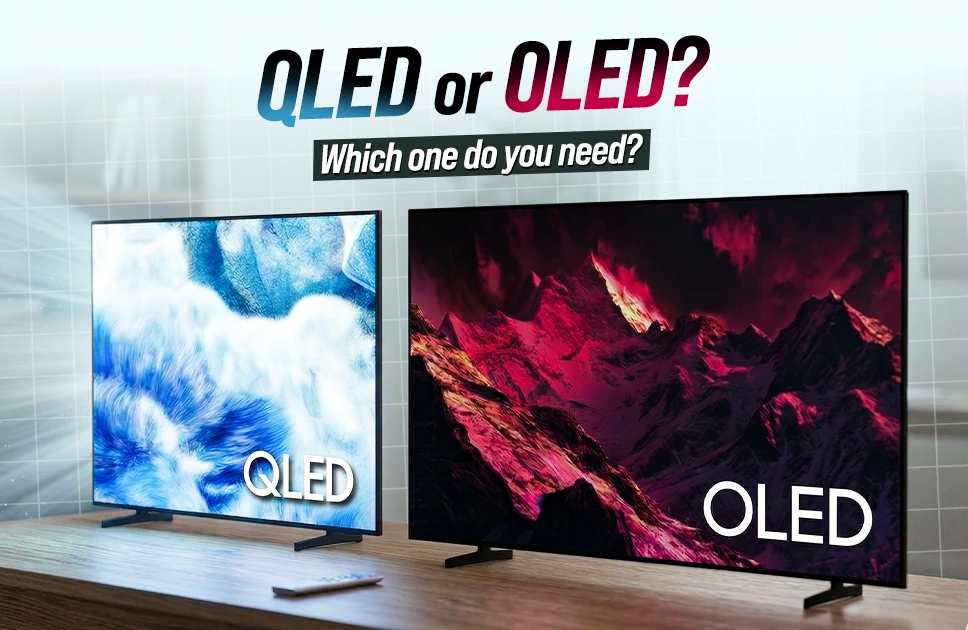
What is The Difference Between QLED and OLED TV?

Ever stood in front of two gorgeous TVs wondering what the difference actually is? You’re not alone. Half the time it feels like TV salespeople are speaking in code; throwing around QLED and OLED like everyone just knows what quantum dots are supposed to do.
The whole thing started decades ago when some researchers accidentally discovered they could make materials glow by running electricity through them. That became OLED. Around the same time, other scientists were messing around with tiny crystals that could change colors. That turned into QLED. Fast forward to today and we’ve got LG and Samsung basically at war over whose approach is better.
OLED works by letting each dot on the screen light itself up or turn completely black. No backlight needed. QLED still uses a backlight but puts these special crystals in front of it to make colors pop and get crazy bright.
Both look amazing, but they’re good at different things. OLED gives you those perfect blacks you see in movie theaters. QLED can get bright enough to hurt your eyes if you’re not careful. One’s better for dark rooms, the other handles bright living rooms like a champ.
So which one should you care about? Depends what matters to you. Let’s break down the QLED vs OLED dilemma once and for all.
Technologies of OLED and QLED
In this section we will discuss how these panels work like what technologies are used, who manufactures it and what makes them unique. Follow along.
QLED Technology Explained
You know how old LCD TVs look terrible when sunlight hits them? QLED fixes that problem. It’s basically Samsung saying “let’s take a regular LCD and make it not suck in bright rooms.”
The secret sauce is quantum dots; think of them as microscopic crystals that get excited when light hits them. Big crystals glow red, tiny ones glow blue, and the medium ones handle green. It sounds complicated, but really they’re just making your TV’s colors way more accurate than the muddy mess you get from cheap LCDs.
Samsung started the whole QLED thing in 2017 because they needed something to compete with OLED. Now TCL and Hisense make them too, each claiming theirs is somehow better.
QLED TVs get absurdly bright. We’re talking 4,000+ nits compared to maybe 500 on your current TV. Walk into any store and the QLED is usually the one that makes you squint. That brightness means you can actually see what’s happening on screen even with windows open and lights on.
Read More: Ultra HD vs OLED TV
OLED Technology Explained
OLED throws out everything you know about how TVs work. Instead of a big backlight shining through the screen, every single pixel makes its own light. When you see black on an OLED, those pixels actually turn off. Not dim but completely off. This is what gives it the near infinite contrast ratio.
It’s made from organic compounds that glow when you run electricity through them. Sounds weird, but it’s actually simpler than QLED. No backlights, no quantum dots, no layers of stuff. Just pixels that light up or don’t.
LG owns the OLED TV game. Sony makes OLED TVs too, but they’re using LG’s screens inside. LG started selling these things back in 2013 with those ridiculous curved TVs nobody wanted. Thankfully they figured out flat screens work better in actual homes.
What makes OLED special is the blacks. When a pixel turns off, it’s actually off; pitch black, not that grayish-black you get from LCD. This makes everything else look incredible because colors aren’t competing with light leaking from behind the screen.
The Technical Foundation
LCD technology hit a wall years ago. Manufacturers kept making slight improvements here and there like better backlights and improved color filters, but they couldn’t solve the core problem. Light from the backlight travels from multiple layers before it reaches your eyes and each layer changes or blocks the light which disrupts picture quality.
OLED fixes this by making each pixel its own light source. No backlight means no light bleeding, no halos around bright objects, and perfect black levels. It’s a completely different approach that solves problems LCD simply can’t.
QLED takes the opposite route. Instead of abandoning LCD, Samsung pushed it to its absolute limits. Quantum dots create incredibly pure colors that old phosphors never could. Advanced backlighting systems with thousands of dimming zones try to copy what OLED does naturally.
Both exist because 4K and HDR content demand better displays. Your old 1080p TV worked fine with mediocre contrast and limited colors. Once streaming services started offering HDR movies and games began showing deeper colors, standard LCDs couldn’t keep up anymore.
Read More: LED vs OLED TV
Picture Quality Face-Off
Put a QLED and OLED side by side and you’ll immediately see why people argue about this stuff online. Both look amazing, but they’re amazing in totally different ways. OLED crushes it in some areas while QLED dominates others. Which one looks better to you depends on what you’re watching and where you’re watching it.
Brightness and HDR Performance
QLED absolutely destroys OLED when it comes to raw brightness. We’re talking 4,000+ nits versus maybe 1,000 nits on OLED. In real terms, QLED can get about four times brighter.
This matters for HDR content. Those bright explosions or sunlit scenes in movies are mastered at brightness levels OLED can’t reach. QLED shows them as the director intended, while OLED has to tone them down.
Put both TVs in a bright living room with windows everywhere and you’ll see the difference immediately. QLED stays vibrant while OLED looks washed out fighting against all that ambient light.
OLED fans argue brightness isn’t everything, and they’re right. OLED’s perfect blacks make its limited brightness feel more impactful. When pixels can turn completely off, even 800 nits looks incredibly bright by comparison.
For HDR gaming or watching movies during the day, QLED wins hands down. But in dark rooms where you want that cinematic experience, OLED’s lower brightness actually works better. It’s not about the numbers on paper but how those numbers work in your actual viewing environment.

Samsung 85QN900D · 85" Neo QLED 8K
Infinity Air design with 8K AI upscaling and ultra-fast motion for sports & gaming.
- 8K AI Upscaling Pro makes every scene incredibly crisp
- Infinity Air Design for an almost floating screen effect
- Quantum Matrix Tech Pro controls 33M+ pixels for deep contrast
- NQ8 AI Gen3 Processor refines textures and smooths fast action
- Motion Xcelerator 240Hz keeps action fluid and crystal clear
Contrast and Black Levels
This is where OLED completely demolishes QLED. When an OLED pixel needs to show black, it turns off completely. Not dark gray, not almost black – actually black. QLED can’t do this because it still relies on a backlight that’s always on behind the screen.
Even the fanciest QLED with thousands of local dimming zones can’t match true black. There’s always some light bleeding through, creating that grayish look in dark scenes. Watch a space movie on QLED and you’ll see the difference – stars floating in dark gray instead of the infinite blackness of space.
This affects everything else on screen too. Colors look more vibrant on OLED because they’re not competing against backlight bleed. A red rose against a black background pops on OLED in ways QLED simply cannot replicate.
QLED tries to compensate with brightness, and in bright rooms it works. But put both TVs in a dark room watching a movie with lots of shadows and night scenes, and OLED wins every time. The contrast between its perfect blacks and bright highlights creates that cinematic look you get at movie theaters.
Color Accuracy and Gamut
OLED actually wins the color accuracy battle. While QLED can produce more saturated colors thanks to quantum dots, that doesn’t necessarily mean better colors. OLED delivers more natural, accurate color reproduction that professionals prefer.
QLED does cover a wider color gamut and can hit more extreme color points, especially bright reds and greens. Those demo videos with tropical fish or vivid flowers look almost hyperreal on QLED. But sometimes that’s the problem – the colors can look oversaturated and unnatural.
OLED takes a more balanced approach. Colors look exactly as they should, especially skin tones and everyday objects. There’s no artificial boosting or oversaturation. What you see is what the content creator intended.
The quantum dots in QLED are impressive tech, but they prioritize wow factor over accuracy. OLED’s organic compounds produce colors that feel more realistic and natural to the human eye.
For content creation or critical viewing, OLED’s color accuracy is hard to beat. But if you want colors that pop off the screen and grab attention, QLED’s more aggressive approach might appeal to you more.
Viewing Angles and Uniformity
OLED absolutely crushes QLED when it comes to viewing angles. Sit anywhere in the room and an OLED looks exactly the same. Colors stay accurate, contrast remains perfect, and brightness doesn’t shift. It’s like the TV was made specifically for your seating position no matter where you sit.
QLED struggles here because of its LCD roots. Move off to the side and you’ll notice colors washing out, contrast dropping, and the whole image looking dimmer. It’s not terrible on modern QLEDs, but it’s definitely noticeable if you’re sitting at an angle.
This makes OLED way better for families or anyone with a wide seating arrangement. Everyone gets the same viewing experience whether they’re dead center or off to the side. QLED works fine if you’re mostly watching from straight ahead, but it punishes anyone stuck with the side seats.
Screen uniformity is another OLED advantage. The entire screen looks consistent because each pixel controls itself. QLED can have slight variations in brightness across the panel, especially in dark scenes where you might notice some areas looking slightly lighter than others.
Gaming and Motion Performance
Gamers look at TVs differently. It’s not just about colors and contrast; it’s about how fast the screen reacts when you hit a button, or how smooth a football match looks when the camera swings across the field. QLED and OLED both promise a “next-gen” experience, but they go about it in different ways. Here’s where the battle really matters for anyone who games or watches fast action.
Gaming Features Comparison
Gamers don’t just care about pretty colors. They care about how fast the screen reacts when you hit a button. OLED usually wins here. Input lag is super low, so everything feels instant. QLED isn’t far behind, but if you’re playing competitively, you might notice the smallest delay.
Both types support VRR and ALLM, which basically keeps gameplay smooth and stops that annoying screen tear. QLED shines in bright rooms. HDR explosions and sunlit scenes look crazy vibrant. OLED, on the other hand is best in the dark. Shadows, night missions, or anything with deep blacks pop in a way that makes you feel like you’re inside the game.
Motion Handling
Fast action can make or break a TV. Sports, racing games, action movies; you notice blur or stutter immediately. OLED takes the lead here because every pixel turns on and off instantly. No backlight to slow things down, so fast scenes stay sharp and smooth. QLED has improved a lot with motion interpolation and faster panels, but it still can’t match OLED’s natural fluidity, especially in really dark or complex scenes.
Watching football on OLED feels like you’re in the stadium. QLED makes bright, sunny matches look fantastic, but when the camera pans quickly or shadows dominate, you might catch slight ghosting.
For gaming and action movies, OLED is more consistent across all types of motion. QLED works well in bright environments, but if you care about smoothness and crisp details when things move fast, OLED clearly pulls ahead.
Next-Gen Console Compatibility
Modern consoles demand a lot, and luckily both QLED and OLED are ready. They handle 4K at 120Hz, which means games look sharp and play smoothly. VRR support is there too, so when the frame rate dips, you don’t get those ugly tears across the screen.
Here’s where things feel different. Fire up a bright HDR game like Forza on a QLED and it’ll light up the room with color and detail. Play the same game on an OLED and the darker tracks feel richer, with shadows that actually look real. QLED loves the spotlight, OLED thrives in the dark.
Input lag is low on both, so you won’t feel behind in fast shooters. In the end, either one makes your console feel truly next-gen. The real choice is your setup: a bright living room points to QLED, a darker space makes OLED feel like magic.

Haier H32K85FX · 32" DLED HD Google TV
Smooth Google TV experience with smart personalization and built-in casting.
- Delivers a smooth UI experience with Google TV OS
- Powered for performance with advanced processing & graphics
- Immersive streaming with top apps pre-installed
- Engineered for personalization via dynamic picture & audio modes
- Crafted for convenience with built-in Chromecast & voice assistant
Durability and Longevity Analysis
A great TV isn’t just about how it looks on day one; it’s about how well it holds up five or ten years down the line. This is where QLED and OLED show their true colors, and the story is very different for each.
QLED tends to play the long game better. Since it uses an LED backlight, there’s no risk of burn-in and very little chance of noticeable image retention. You could leave a channel logo or sports scoreboard sitting on screen all day, and it won’t leave a permanent mark.
The main thing QLED panels face is gradual brightness loss, but it happens so slowly most people won’t catch it unless they’re comparing side by side with a brand-new unit. OLED is trickier. Its self-emitting pixels look incredible but are made from organic compounds that naturally degrade over time.
That means brightness slowly fades, and in some cases you might see uneven wear if you constantly display the same static content. Burn-in is the big scare word here, and while it’s less common than online forums make it sound, it’s still a possibility if you use your TV heavily for gaming HUDs or 24/7 news.
The good news: most modern OLEDs include built-in tools like pixel shifting and compensation cycles that quietly reduce the risk. Outside of burn-in, environmental factors also matter. QLED handles heat and humidity better, making it safer for bright rooms or less controlled environments.
OLEDs run cooler overall and use less power when showing darker images, but crank up a bright HDR scene and power draw can spike higher than QLED.
Maintenance is simple on both. A microfiber cloth and occasional dusting is usually all it takes, but OLED owners should be a little more cautious with screen cleaners since the surface is more delicate.
In terms of long-term stability, QLED still feels like the safer investment if you want a set-and-forget panel, while OLED rewards you with jaw-dropping image quality as long as you treat it with a bit more care.
The Verdict: When Each Technology Wins
By now it’s obvious there isn’t a single “best” TV. QLED and OLED both crush it, just in different ways. One handles bright rooms and long hours better, the other gives you a cinematic punch you can’t unsee once you’ve experienced it. This is where we break down exactly when each one makes more sense.
QLED Advantages
QLED is the safe bet if you want a TV that can handle anything you throw at it without much babysitting. Its crazy brightness means it thrives in living rooms with big windows, ceiling lights, or anywhere you can’t always control the lighting. HDR movies, sports during the day, or gaming in a bright setup all look fantastic because QLED doesn’t wash out.
It’s also the sturdier option long-term. No real burn-in worries, less chance of uneven wear, and generally higher lifespan thanks to its LED backbone. You can leave news channels, sports tickers, or a console menu sitting on screen without stressing about ghost images burning in.
For families, QLED makes even more sense. Kids can binge cartoons, someone else can game for hours, and it’ll still look the same years later. Add in the fact that QLED sets often come in bigger sizes for cheaper. This is why it is often the more practical choice for people looking for a cheaper alternative with a larger screen size.
OLED Advantages
OLED is all about picture quality that makes you stop and stare. Those self-lit pixels create blacks so deep that every color around them looks more alive. Watching a movie in a dark room feels almost theatrical, with shadows, highlights, and fine details blending together in a way QLED just can’t copy. If you care about cinematic immersion, OLED is the one.
Gamers also love OLED for the instant response. Input lag is super low, motion looks smoother, and darker game environments feel more realistic. It’s not just technically impressive; it feels different when you’re actually playing.
The trade-off is that OLED asks for a little more care. Static images left on screen for hours aren’t ideal, and it shines best in rooms where you can control the light. But for movie nights, binge sessions, or anyone chasing the absolute best-looking image, OLED is the kind of upgrade you can’t unsee.
Conclusion
QLED and OLED aren’t just two ways of making a TV; they’re two completely different approaches to how a screen should look and feel. One leans on raw power with brightness and durability, the other focuses on finesse with blacks and color accuracy that make movies feel alive. Neither cancels the other out; they simply excel in different environments.
If your setup is a bright living room, QLED makes more sense. If you’re chasing that cinematic look in a darker space, OLED will spoil you for anything else. Both will keep evolving, too. QLED is getting better at dimming and color precision, while OLED panels are slowly pushing brightness and burn-in resistance further every year.
So the real answer isn’t about which technology wins, but which one wins for you. Decide based on your room, your habits, and what you actually watch. That’s how you’ll land on the TV that doesn’t just look great in the store but keeps impressing you years down the road.
And if you are looking for a place to buy OLED and QLED TVs you can check out Apple Gadgets as we have a wide collection of TVs from all of your favourite brands. Our sales reps are also quite knowledgeable and will provide you with appropriate suggestions depending on your budget and will not just push you to the most expensive one.
That’s about it, see you in another blog.
FAQ
Mohammad Shariful Islam is the CEO and MD of Apple Gadgets, a leading e-commerce and retail chain for gadgets in Bangladesh. He has a passion for technology, entrepreneurship, and holds a decade of experience in gadget E-Commerce. He’s committed to providing the best possible shopping experience for customers by delivering the latest and trendy gadgets.