How to Choose the Best TV in Bangladesh: A Complete TV Buying Guide

Buying a new TV is not something we do every day, and with so many options in the market, it can feel a little confusing. From screen sizes to smart features, every TV comes with its own set of highlights. The good news is, you don’t need to be a tech expert to pick the right one. A TV should match your lifestyle, you might want a simple screen for casual watching, a smart hub for streaming, or a big cinematic 4K TV for movies and gaming.
At Apple Gadgets, we want to make your choice easier. This guide will walk you through the key things you need to check before buying a TV in 2025. By the end, you’ll know exactly what features matter most for your needs and budget, so you can bring home the perfect entertainment partner.
Screen Size & Viewing Distance
The first thing to decide when buying a TV is the screen size. Bigger screens are not always better. The right size depends on the space in your room and how far you usually sit from the TV. If the screen is too large for a small room, you might feel uncomfortable. On the other hand, if the screen is too small for a big living room, you will miss the immersive experience. So, rather than being choosy you have to be tricky in this case.
As a simple rule, people usually sit around 1.5 to 2.5 times the diagonal size of the TV away from the screen. For example, a 32-inch TV works well in a small bedroom, while a 55-inch or 65-inch TV is perfect for a medium or large living room. If you want a true home-theater feeling, going above 65 inches is an excellent choice.
Look at the chart below, though it is not a strict rule, it will give you an idea of which size of screen is suitable for your room:
| TV Screen Size | Best Viewing Distance |
| 32-inch | 4 to 6 feet |
| 43-inch | 5 to 8 feet |
| 50-inch | 6 to 10 feet |
| 55-inch | 7 to 11 feet |
| 65-inch | 8 to 13 feet |
| 75-inch | 9 to 15 feet |
| 85-inch | 10 to 16 feet |
Display Technology – LED, QLED, OLED, Mini-LED, MicroLED
This is the aspect where you can be choosy and make a choice based on your expectation. Display technology makes the biggest difference in how your picture looks. Each type of display technology works in a different way. Understanding the basics will help you a lot while you are choosing the right tv for your own.
LED/LCD TVS are the most common and affordable option in our country. In this technology they use a backlight to produce images, but blacks often look gray in dark rooms. Full array backlighting is better than edge-light because it improves the contrast.
QLED adds a quantum dot layer that boosts brightness and color. These TVs shine in bright rooms and make HDR highlights pop. However, they still depend on a backlight, so blacks are not as deep as OLED.
Mini-LED is an upgraded version of LED with smaller backlight zones. This allows better control of brightness, stronger HDR, and reduced halo around bright objects. They are excellent for both bright rooms and mixed use.
OLED TVs are different because each pixel lights up on its own. This gives perfect blacks, infinite contrast, and wide viewing angles. They are amazing for movies and gaming but usually not as bright as Mini-LED. There is also a small risk of burn-in if static images stay on screen for long periods, though modern OLEDs manage this much better now.
MicroLED is the newest and most advanced option. It combines the strengths of OLED and LED, offering top brightness, deep blacks, and no burn-in. Right now, it’s very expensive and mainly for ultra-premium setups.
For Better understanding, look at the table below:
| Technology | Main strength | Main weakness | Best for |
| OLED | True blacks, contrast, wide viewing angle, great motion | Lower peak brightness versus top Mini-LED, possible burn-in in extreme static use | Movie lovers, dark-room viewers, cinephile setups |
| QLED (LCD + quantum dots) | High brightness, vivid colors, strong HDR highlights | Blacks depend on backlight; can have blooming with coarse zones | Bright rooms, HDR highlights, general TV watching |
| Mini-LED | High brightness, fine local dimming, strong HDR, less halo | Can still show some blooming in extreme scenes, price higher than basic LED | Bright-room HDR, mixed use, gamers who want high brightness |
| LED / LCD (basic) | Most affordable, solid everyday TV | Weaker blacks, limited HDR impact | Budget buyers, secondary rooms, simple use |
| MicroLED | Top-level brightness and contrast, no burn-in | Extremely expensive, limited availability | Ultra-premium home theaters and commercial installs |
If you love watching movies in a dark room and want the deepest blacks, OLED will give you the best cinematic experience. For bright rooms and high-impact HDR content, QLED or Mini-LED is a better choice because of their higher brightness and vivid highlights. Gamers should focus on TVs that offer 120Hz refresh rates and HDMI 2.1 support, where both OLED and Mini-LED perform really well. If you are on a tight budget, a good LED/LCD TV with full-array dimming can still provide solid performance without spending too much.
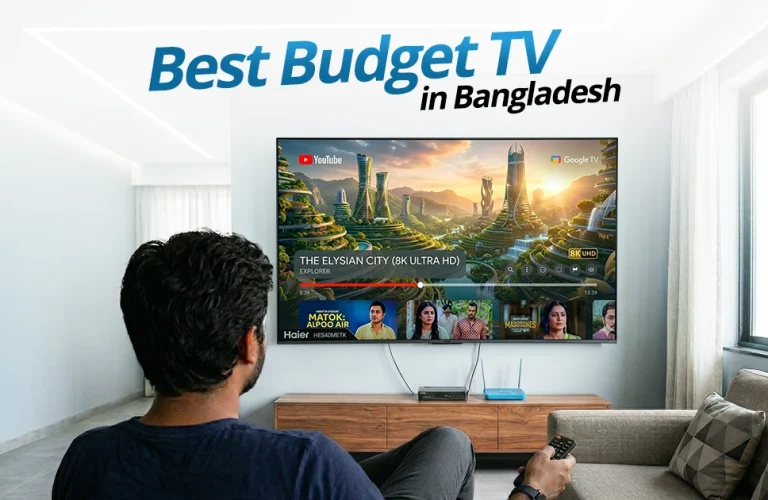
Read More: Best Budget TVs in Bangladesh
Resolution: HD, Full HD, 4K, and 8K
Resolution refers to the number of pixels on a TV screen, and more pixels mean clearer and sharper images. In 2025, 4K has become the most common choice, but you will still see HD, Full HD, and even some 8K models in the market.
HD, also known as 720p, offers 1280 x 720 pixels and is mostly found in very small and budget-friendly TVs. It is fine for casual watching in kitchens or small bedrooms but does not provide enough detail for a main living room setup. Full HD, or 1080p, steps up with 1920 x 1080 pixels. It is still used in many entry-level TVs, often up to 43 inches, and delivers decent picture quality. However, since most content today is produced in higher resolutions, Full HD is slowly becoming less future-ready.
The real sweet spot is 4K, which delivers 3840 x 2160 pixels, four times sharper than Full HD. This is now the standard for most new TVs and gives a big jump in detail and clarity. Streaming platforms like Netflix, Disney+, and Amazon Prime already provide most of their content in 4K HDR, making it the most practical choice for buyers.
At the very high end, there is 8K resolution with 7680 x 4320 pixels. It offers incredible detail, 16 times sharper than Full HD, but content support is still very limited. 8K is mainly useful for very large TVs, usually 75 inches and above, where the extra sharpness is noticeable. Right now, it remains a premium option for those who want to be future-ready.
Buying Tip: For most households in Bangladesh, a 4K TV is the best balance of price, performance, and content availability. Full HD can still be acceptable in smaller, budget TVs, while 8K is only worth considering if you are investing in a large premium setup.
Refresh Rate & Performance
Refresh rate shows how many times per second a TV screen refreshes the image, measured in hertz (Hz). A standard TV usually comes with a 60Hz refresh rate, which is enough for regular watching such as dramas, news, and movies. However, when it comes to sports, action scenes, or gaming, a higher refresh rate makes a noticeable difference. A 120Hz TV refreshes the image twice as fast as a 60Hz model, giving you smoother motion, less blur, and a more lifelike viewing experience.
For gamers, refresh rate plays an even bigger role. Fast-paced games benefit from 120Hz panels, especially when combined with features like VRR (Variable Refresh Rate) and ALLM (Auto Low Latency Mode). These technologies reduce screen tearing and input lag, making gameplay more responsive. Many modern consoles such as PlayStation 5 and Xbox Series X are designed to work best with 120Hz TVs, so investing in one gives you a future-proof gaming setup.
Read More: Best TV for PS5
For movie lovers, refresh rate also matters, but not in the same way as for gamers. Many films are shot at 24 frames per second, and TVs with motion smoothing features can help reduce judder without making the picture look unnatural. It is always best to test a TV in-store with both sports and movies to see how well it handles fast-moving scenes.
Buying Tip: If you mainly watch everyday content, a 60Hz TV will be enough. If you enjoy sports or gaming, choosing a 120Hz TV will give you much smoother performance. For gamers, check for VRR and HDMI 2.1 support along with 120Hz to get the best experience.
Smart TV Features & Operating System
Modern TVs are more than just screens; they work like smart hubs for entertainment. A Smart TV connects to the internet and gives you access to apps, streaming services, and even voice control. Instead of depending on an external device, you can watch Netflix, YouTube, Disney+, or Amazon Prime directly from the TV. Many smart TVs also support screen mirroring, so you can easily share content from your phone or laptop.
The operating system (OS) is what makes the TV easy or difficult to use. Popular platforms include Android TV, Google TV, WebOS (LG), and Tizen (Samsung). Each has its own look and features, but the goal is the same: smooth navigation and access to popular apps. Google TV and Android TV are known for their wide app support and built-in Chromecast, while WebOS and Tizen focus on simple menus and fast performance.
Another feature to consider is voice assistant support. Many TVs now work with Google Assistant, Alexa, or even Siri through Apple devices. This allows you to search for shows, control volume, or even manage smart home devices with simple voice commands. Some high-end models also come with advanced AI upscaling, which improves the quality of older or lower-resolution videos.
Buying Tip: Always check if the TV has your favorite apps pre-installed and if the OS feels easy to use. A smooth operating system with regular updates ensures your TV stays useful for years. For users in Bangladesh who rely on streaming, a TV with Android or Google TV often provides the most flexibility.
Audio Quality
While picture quality often gets the most attention, sound is equally important for an enjoyable TV experience. Many modern TVs come with built-in speakers that deliver clear dialogue and balanced sound for everyday viewing. However, slim TV designs often limit the power of in-built audio. If you enjoy movies, music, or gaming, you should look for TVs that feature enhanced sound technologies such as Dolby Audio or DTS. These provide richer bass, wider soundstage, and more immersive effects. For larger living rooms, consider pairing your TV with a soundbar or home theater system for a cinematic feel. Good audio ensures you don’t just see the action you feel it too.
Connectivity & Smart Features
A good TV should easily connect with the devices and services you use every day. The first thing to check is the number of HDMI ports. If you plan to connect a gaming console, a soundbar, and a set-top box, having at least three ports will save you from the hassle of constantly unplugging cables. USB ports are also handy for watching movies or viewing photos straight from a flash drive.
On the smart side, TVs now come with platforms like Android TV, Google TV, Tizen, or webOS. These let you stream Netflix, YouTube, or Prime Video right out of the box. Built-in voice assistants such as Google Assistant or Alexa add another layer of convenience by letting you search or control settings with simple commands. Wi-Fi and Bluetooth support make it even easier to pair your headphones, speakers, or smartphone for casting content.
When your TV has strong connectivity and smart features, it doesn’t just play shows — it becomes a central hub for entertainment, gaming, and even smart home control.
Gaming Features
If you love gaming, the right TV can make a big difference in how smooth and immersive your experience feels. Look for TVs that offer a high refresh rate, ideally 120Hz, so fast movements in action games look sharp without motion blur. Low input lag is equally important because it ensures your commands register instantly, giving you a competitive edge in fast-paced games.
Many modern TVs also support technologies like VRR (Variable Refresh Rate) and ALLM (Auto Low Latency Mode). VRR keeps the frame rate consistent, avoiding stutters or screen tearing, while ALLM automatically switches the TV to game mode when it detects a console, saving you the trouble of changing settings manually.
Some high-end models also come with HDMI 2.1, which is essential if you own a PlayStation 5 or Xbox Series X. With these features, your TV won’t just display your games — it will help you play them at their best.
Read More: Best Gaming TV
Final Words: Choosing the Right TV in 2025
Buying a TV in 2025 is about more than just screen size or price. Display technology, resolution, refresh rate, audio quality, smart features, and connectivity all combine to define your viewing experience. For most buyers in Bangladesh, a 4K Smart TV offers the best balance of clarity, content availability, and long-term value. OLED TVs are ideal for cinematic experiences and dark-room viewing, while QLED or Mini-LED TVs perform best in bright rooms with vivid HDR content.
Gamers should prioritize high refresh rates, low input lag, and HDMI 2.1 support, while families looking for convenience will benefit from a user-friendly smart TV platform and good connectivity options. Budget-conscious buyers can still find excellent LED or Full HD TVs that deliver reliable performance without overspending.
Ultimately, the best TV is one that fits your room, matches your viewing habits, and offers features you’ll actually use. By considering these factors carefully, you can make a confident choice that brings years of enjoyable viewing for movies, sports, gaming, and streaming.
Now that you know what to look for, it’s time to find the TV that’s right for you. Explore the latest models at Apple Gadgets and make your viewing experience truly enjoyable!
Borhan Uddin Alif is a writer with 3 years of experience, focusing on technology, marketing, and storytelling, and enjoys exploring various niches and topics.